
Medicare Savings Programs in Pennsylvania: Help With Medicare Costs

Medicare helps with a lot, but it doesn't cover everything. Part B premiums, deductibles, coinsurance, copays, and prescription costs can put real pressure on a retirement budget.
If those bills are starting to feel unmanageable, Pennsylvania's Medicare Savings Programs, often called MSPs, may be worth a closer look. Depending on the program, they can help with your Part B premium, Medicare cost-sharing, or even a Part A premium.
Here in Blair County and across Central PA, we meet people who may qualify but never apply. Usually, they've heard the word "Medicaid" and assume they won't be eligible. That's understandable, but it's not always how this works. Let’s take a closer look at how Medicare Savings Programs work, who qualifies and how to apply!
📌 New to Medicare? Check Out A Beginner's Guide to Medicare: What It Is, How It Works, and Where to Start
What Are Medicare Savings Programs?
Medicare Savings Programs are state-administered programs that help people with limited income and resources pay Medicare costs. In Pennsylvania, the Department of Human Services, or DHS, reviews the application and determines the program or Medicaid category that fits your situation.
The important thing to remember is this: you don't have to figure out the label yourself before you apply. DHS looks at your income, resources, and Medicare status, then determines what help you may qualify for.
For 2026, Medicare.gov lists the federal baseline income and resource limits below. Pennsylvania can use its own rules in some situations, so DHS makes the final eligibility decision.

Truman’s Tip
Don't rule yourself out because you're close to an income or resource limit. DHS reviews the full application and decides which program or category applies. Applying is the only way to know for sure!
MSPs and Full Medicaid: What's the Difference?
This is one of the most confusing parts of the conversation, so here's the plain-English version.
A Medicare Savings Program is designed to help with Medicare costs. Depending on the level of help, it can pay a Medicare premium and sometimes the deductibles, coinsurance, and copays Medicare leaves behind.
Full Medicaid, called Medical Assistance in Pennsylvania, is broader. It can cover Medicare costs and certain health services that Medicare may not cover, depending on the person's Medicaid category.
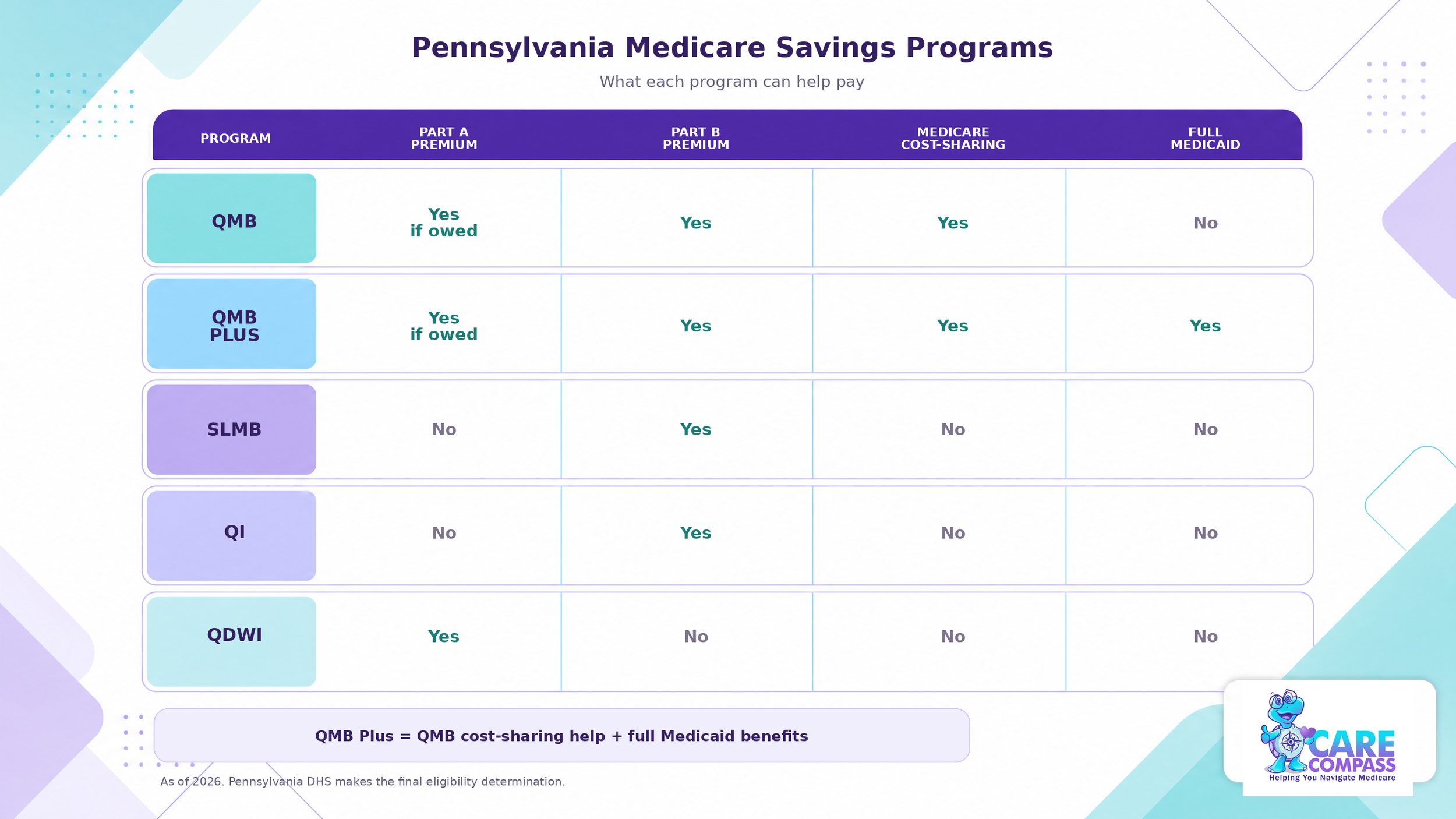
In Pennsylvania, QMB Plus (AKA QMB+) is where those two forms of help overlap. A person with QMB Plus gets the QMB Medicare cost-sharing help AND full Medicaid benefits through Healthy Horizons. QMB by itself doesn't automatically mean someone has full Medicaid.
You can think of it this way:
QMB cost-sharing only: Help paying Medicare Part A and Part B costs, but not full Medicaid benefits.
QMB Plus (QMB+): The same QMB Medicare help PLUS full Medicaid benefits.
Pennsylvania DHS decides whether an applicant qualifies for QMB cost-sharing only, QMB Plus, or another Medicaid category. That's why it makes sense to apply instead of trying to sort it out from a chart at home.
The Four Medicare Savings Programs
1. Qualified Medicare Beneficiary (QMB)
QMB offers the broadest Medicare cost-sharing help. It can pay the Part A premium (if you owe one), the Part B premium, and Medicare-covered deductibles, coinsurance, and copays.
If you qualify for QMB, Medicare providers generally can't bill you for Medicare-covered deductibles, coinsurance, or copays. A small Medicaid copay may apply in limited situations.
2026 federal baseline income limits:
Individual monthly income: $1,350
Married couple monthly income: $1,824
Resources: $9,950 for an individual and $14,910 for a married couple.
2. Specified Low-Income Medicare Beneficiary (SLMB)
SLMB helps pay the monthly Part B premium. You must have both Part A and Part B to qualify.
For most people, the standard Part B premium is $202.90 per month in 2026. That's more than $2,400 over a full year.
2026 federal baseline limits:
Individual monthly income: $1,616
Married couple monthly income: $2,184
Resources: $9,950 for an individual and $14,910 for a married couple

3. Qualifying Individual (QI)
QI also helps pay the Part B premium, and you must have both Part A and Part B to qualify.
You have to apply every year to continue receiving QI assistance. States give priority to people who had QI benefits the previous year, so it's important not to let an application lapse.
QI is for people who don't qualify for another Medicaid coverage or benefit.
2026 federal baseline limits:
Individual monthly income: $1,816
Married couple monthly income: $2,455
Resources: $9,950 for an individual and $14,910 for a married couple
4. Qualified Disabled and Working Individual (QDWI)
QDWI is a narrower program. It can help pay the Part A premium for someone with a disability who is working and lost premium-free Part A and Social Security disability benefits after returning to work.
2026 federal baseline limits:
Individual monthly income: $5,405
Married couple monthly income: $7,299
Resources: $4,000 for an individual and $6,000 for a married couple
Extra Help With Prescription Costs

One of the biggest benefits of QMB, SLMB, or QI is that qualifying usually gives you Extra Help with Medicare Part D prescription drug coverage automatically.
In 2026, Extra Help means a $0 Part D plan premium and $0 deductible. At a participating pharmacy, you'll pay no more than $5.10 for a generic drug and $12.65 for a brand-name drug covered by your plan. Once your total drug costs reach the program threshold, you'll pay $0 for covered drugs for the rest of the year.
Extra Help can also protect you from a Part D late enrollment penalty while you receive it. If prescription costs have become difficult, that's one more reason to see whether you may qualify.
📌 Planning ahead for next year? Read What Medicare Part D Will Cost You in 2027.
What Counts as a Resource?
A resource is something you own that can count toward an MSP limit. Common examples include money in checking, savings, or retirement accounts, as well as stocks and bonds.
Medicare.gov says states generally don't count your home, one car, a burial plot, up to $1,500 set aside for burial expenses, furniture, and other household or personal items. That doesn't mean every situation is automatic, but it gives you a much clearer starting point than trying to guess whether ordinary possessions count against you.
If you have a joint account, a burial fund, or another asset you're unsure about, don't assume you're ineligible. Apply or ask PA MEDI or your local County Assistance Office for help.
How to Apply in Pennsylvania
You apply for Medicare Savings Programs through Pennsylvania, not directly through Medicare.
Online: Apply through COMPASS.
By phone: Call Pennsylvania's application line at 1-866-550-4355.
📌 Related reading: How Much Does Medicare Really Cost Each Month in Blair County, PA?

Summary
If your Medicare premium, copays, or prescription costs are stretching your budget, it's worth checking whether a Medicare Savings Program could help. Care Compass doesn't process MSP applications, but we can help you understand how this assistance fits into your broader Medicare coverage and point you toward the right Pennsylvania resources. You can also read 10 Reasons to Work with a Local Medicare Agent in Blair County, PA to learn how a local conversation can make Medicare decisions more manageable!

Care Compass is an independent insurance agency that helps seniors navigate the complexities of Medicare and other Senior Products. Our services are offered at NO COST! Care Compass is proudly owned and operated in Blair County, Pennsylvania. We provide Medicare insurance assistance to the residents of Altoona, Hollidaysburg, Duncansville and the surrounding region. If you need assistance with Medicare, contact Care Compass today!
Sources:
Medicare Savings Programs (federal program details and 2026 limits): https://www.medicare.gov/basics/costs/help/medicare-savings-programs
Extra Help (2026 Part D assistance): https://www.medicare.gov/basics/costs/help/drug-costs
PA DHS Medical Assistance Eligibility Handbook, QMB and QMB Plus: http://services.dpw.state.pa.us/oimpolicymanuals/ma/388_Buy-In/388_1_General_Policy.htm
PA Department of Human Services, Healthy Horizons overview: https://www.pa.gov/agencies/dhs/resources/aging-physical-disabilities/medicaid-older-people-and-people-with-disabilities
PA MEDI counseling: https://www.pa.gov/agencies/aging/aging-programs-and-services/pa-medi-medicare-counseling
Pennsylvania COMPASS application: https://www.compass.dhs.pa.gov/
