
How to Use Your Part B Special Enrollment Period When Losing Employer Coverage

If you decided to keep working past age 65 and delayed your Medicare enrollment because you had health insurance through your employer, you made a very common and often smart financial decision. However, when that employment ends, the clock starts ticking. Transitioning from employer coverage to Medicare requires navigating a specific set of rules and strict deadlines.
At Care Compass, we frequently help seniors in Blair County and Central PA manage this exact transition. The process relies on a window of time known as a Special Enrollment Period (SEP). Technically, this SEP applies to both Part A and Part B, but because most people in this situation already have Part A (which is usually premium-free), the focus almost always falls on Part B enrollment, which carries a permanent late penalty if missed. That is why you’ll hear it commonly referred to as the "Part B SEP." If you understand how this window works and what paperwork is required, you can seamlessly transition to Medicare without any gaps in coverage or lifetime late enrollment penalties!
📌 Back to Basics: A Beginner's Guide to Medicare: What It Is, How It Works, and Where to Start
Understanding the 8-Month Enrollment Window
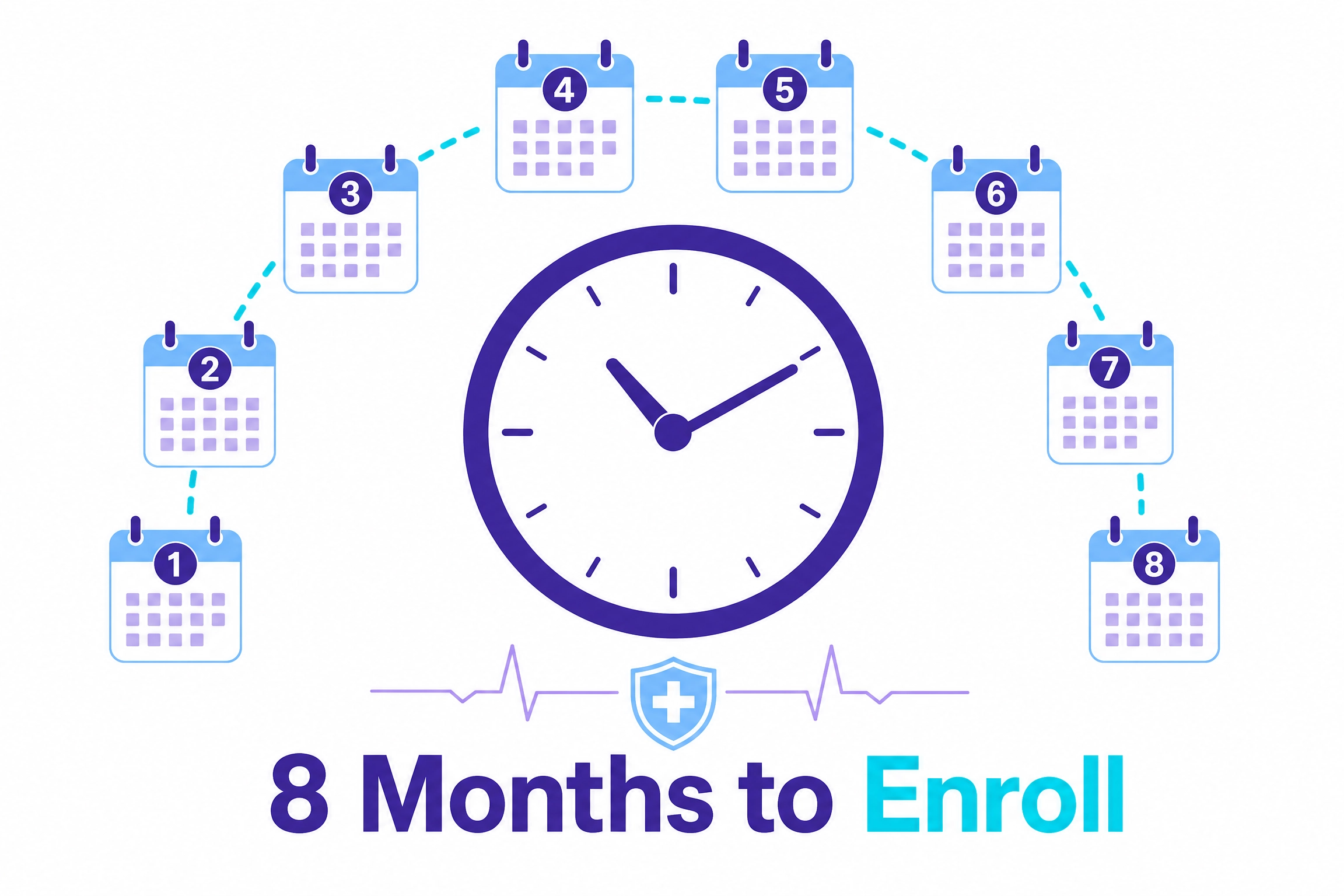
When you or your working spouse finally retire or lose your employer-sponsored health insurance, you are granted an eight-month Special Enrollment Period to sign up for Medicare Part A and Part B. This window allows you to enroll outside of the standard Medicare Initial Enrollment Period without facing any late penalties. Your Special Enrollment Period starts on the date your employment ends or the date your employer-sponsored coverage ends.
But the rules for Part D are slightly different and much stricter. While the eight-month window applies to Medicare Parts A and B, you also need to secure prescription drug coverage (Part D).
When you lose your employer coverage, you only have 63 days to enroll in a Medicare Part D prescription drug plan or a Medicare Advantage plan that includes drug coverage. If you go 63 continuous days or more without "creditable" Rx coverage (coverage that is expected to pay, on average, at least as much as Medicare's standard prescription drug coverage), you will face a Part D late enrollment penalty.
Because the Part D window is only 63 days, it is highly recommended that you handle your Part B and Part D enrollments simultaneously as soon as your employer coverage ends.
The "Active Employment" Requirement
One of the most common and costly mistakes people make is assuming that severance packages, retiree health benefits, or COBRA coverage will extend their Special Enrollment Period, but they don’t!
To qualify for this specific SEP, your health coverage must be based on ACTIVE employment. Once you stop actively working, your eight-month window begins immediately, regardless of whether you accept COBRA or retiree benefits. If you ride out 18 months of COBRA coverage before applying for Medicare, you will have missed your Special Enrollment Period entirely and will be subject to a permanent late enrollment penalty.
📌 Learn More: Working Past 65? Five Costly Mistakes Medicare Beneficiaries Make

The Paperwork: CMS-40B and CMS-L564
If you already have Medicare Part A and only need to enroll in Part B using your Special Enrollment Period, you must prove to the Social Security Administration that you had coverage through active employment. This process requires two specific forms:
Form CMS-40B (Application for Enrollment in Medicare Part B): This is your actual application for Part B medical insurance. You will fill this out entirely yourself.
Form CMS-L564 (Request for Employment Information): This form provides the proof of your employer coverage. You will complete Section A and your employer's Human Resources department must complete Section B. The employer's signature verifies the dates of your employment and the dates you were covered under their group health plan.
Once both forms are complete, you submit them together to your local Social Security office via mail, fax, or by dropping them off in person. You can find your local office using the SSA Office Locator.

Truman’s Tip
One major advantage of using the paper CMS-40B form instead of enrolling online is that you can choose your Part B start date up to three months in advance. If you enroll online, the system typically locks you into the next available month. By submitting the paper form, you have the flexibility to time your start date precisely so your Medicare coverage begins the day after your employer coverage ends, with no gap. This is one of the most important reasons we recommend the paper route for anyone using the SEP!
What If You Haven't Enrolled in Part A Yet?
Most people who delayed Medicare because of employer coverage already have Part A, since it is typically premium-free and many people enroll at 65 even if they delay Part B. However, if you delayed both Part A and Part B, there are a few important nuances to understand before you apply.
First, Part A can backdate your coverage by up to six months, but it will never go back further than the month you turned 65. This means that if you apply for Part A several years after turning 65, your coverage will begin six months before your application date.
Second, when you apply for both Part A and Part B online, the Social Security Administration's online system does not give you the ability to choose a specific Part B effective date. The system will assign one for you, which may not align with when your employer coverage ends. This can result in either a gap in coverage or an unintended period of dual coverage.
For this reason, if you are applying for both Part A and Part B at the same time, we strongly recommend calling your local Social Security office to schedule an in-person or phone appointment rather than completing the application online. Speaking directly with an SSA representative gives you the ability to discuss your specific situation, confirm your Part A backdating implications, and select a Part B start date that works seamlessly with your employer coverage end date.
What to Do When Your HR Department Won't Cooperate
In a perfect world, you hand the CMS-L564 to your HR department, they sign it, and you’re on your way, but in reality, this step can cause significant stress. We sometimes hear from clients whose former employers have gone out of business or whose large corporate HR departments are completely unresponsive to requests for signatures.
If your employer cannot or will not complete Section B of the CMS-L564, you’re not out of luck. The Social Security Administration allows you to self-attest by providing alternative documentation that proves you had active employer coverage.
If you find yourself in this situation, you should complete Section A of the CMS-L564 yourself. In Section B, attach a brief cover letter stating that your employer is unresponsive or no longer in business, and that you are attaching alternative evidence of your coverage.
You should gather and attach as many of the following documents as possible:
W-2 forms
Pay stubs showing health insurance premium deductions
Health insurance cards showing a policy effective date
Tax returns showing health insurance premiums paid
Explanation of Benefits (EOBs) from your insurance carrier showing claims paid by the group plan
By submitting your CMS-40B, your partially completed CMS-L564, your cover letter, and your alternative evidence, you can successfully secure your Part B enrollment without relying on an unresponsive HR department.

Summary
Transitioning from employer coverage to Medicare involves strict timelines and unforgiving penalties, but you don’t have to navigate it alone! The key steps are straightforward: know when your eight-month window begins, use the paper CMS-40B and CMS-L564 forms to control your start date, and do not let an unresponsive HR department derail your enrollment. If you are applying for both Part A and Part B at the same time, call your local Social Security office directly rather than relying on the online application.
If you are still working past 65 and want to understand how your employer coverage interacts with Medicare before you retire, our comprehensive guide to Medicare and group health insurance is a great place to learn more!
If you live in Altoona, Hollidaysburg, Duncansville, or anywhere in the surrounding region, Care Compass is here to help! We can review your timeline, ensure your paperwork is in order, and compare your options for Medicare coverage! Schedule your NO COST consultation today!

Care Compass is an independent insurance agency that helps seniors navigate the complexities of Medicare and other Senior Products. Our services are offered at NO COST! Care Compass is proudly owned and operated in Blair County, Pennsylvania. We provide Medicare insurance assistance to the residents of Altoona, Hollidaysburg, Duncansville and the surrounding region. If you need assistance with Medicare, contact Care Compass today!
